

Can one drone locate and pursue another by listening to the sound of its propellers? SonicFly approaches that question as a problem in embodied passive aeroacoustic perception: a flying robot estimates the relative bearing and range of another aircraft from the sound that flight already produces.
The distinction matters. The follower does not emit a sonar pulse, receive the leader’s position, or rely on an external microphone array. It must recover a weak target signature while its own propellers, motors, airflow, and motion dominate the acoustic scene. Every control action also changes the geometry and, therefore, the next observation.
Presented by researchers from Duke University’s General Robotics Lab, SonicFly combines rotorcraft-aware acoustic design, a four-microphone array, a neural bearing-range estimator, confidence-aware temporal filtering, and closed-loop control. The result is not precise formation flight. It is evidence that naturally generated flight sound can become an actionable, complementary sensing channel.
What makes passive aeroacoustic perception difficult?
A multirotor does not produce featureless noise. Periodic blade passage creates tonal components and harmonics, while motor vibration, aerodynamic loading, wake interactions, and the airframe add further structure. For a rotor with  blades rotating at
  revolutions per minute, the blade-passing frequency is
![\[ f_{\mathrm{BPF}}=\frac{N_b\Omega}{60}. \]](https://sigmoidal.ai/wp-content/ql-cache/quicklatex.com-61f0a481a4a7eb67c6dc5323b9779daa_l3.png "Rendered by QuickLaTeX.com")
This relationship connects propulsion mechanics to acoustic observability. Blade count and motor speed influence where tonal energy appears in the spectrum. In practice, attitude and thrust change those frequencies over time, but the harmonic organization remains a useful physical prior.
The target signal, however, is mixed with a far stronger source: the listening drone itself. The follower’s propellers, motors, downwash, structural vibration, and surrounding wind produce a nonstationary acoustic field around the microphones. Meanwhile, the leader’s sound attenuates with distance. The system is therefore solving more than drone-sound detection; it is estimating relative state from residual cues embedded in ego-noise.
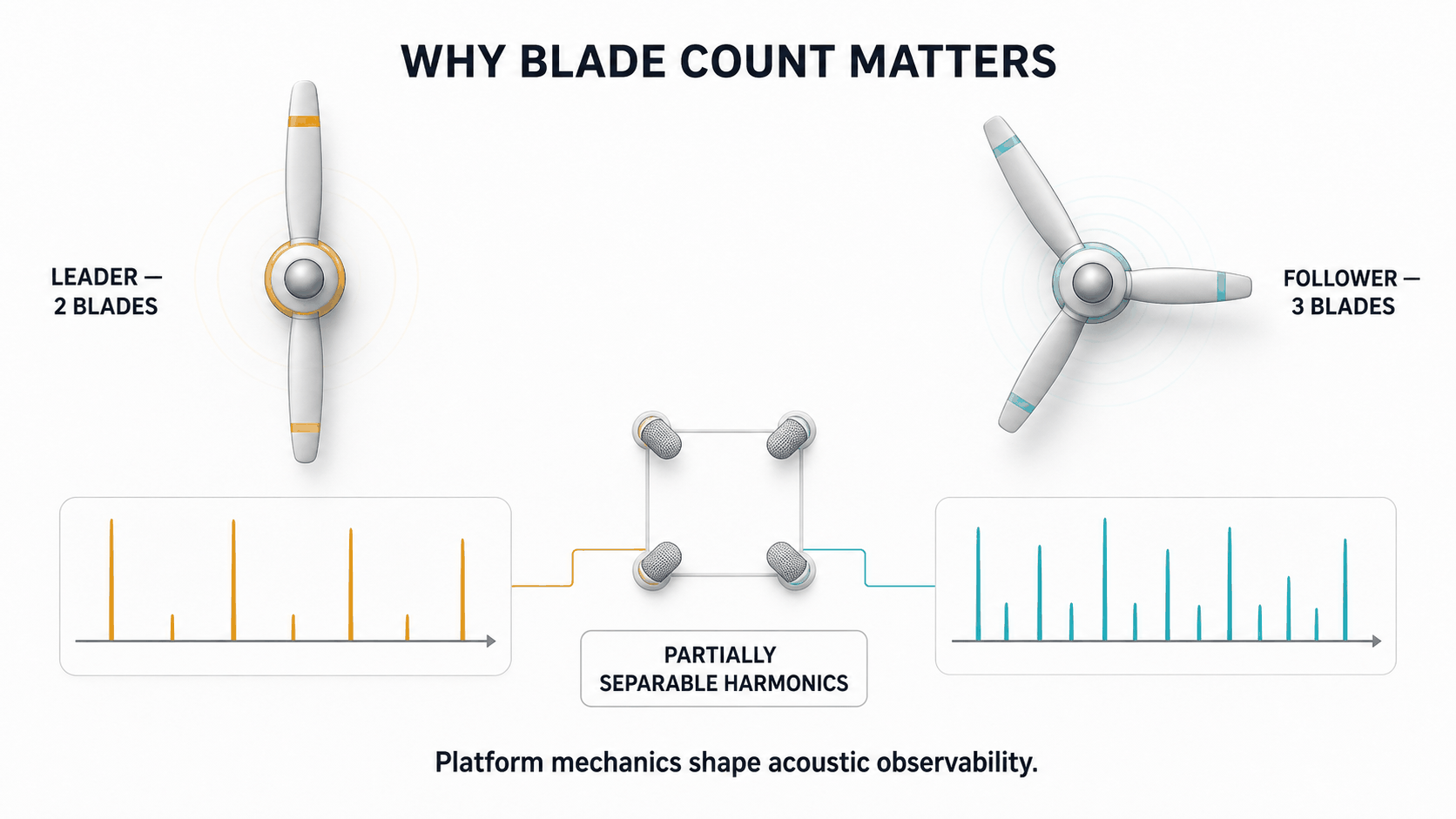
Different blade counts create distinct harmonic spacing. This does not isolate the aircraft completely, but it makes portions of the leader’s signature more observable within follower ego-noise. Original Sigmoidal illustration.
SonicFly makes the sensing problem more observable by using two-blade propellers on the leader and three-blade propellers on the follower. The aircraft are not acoustically isolated: their harmonics still overlap. The difference creates frequency regions in which leader-related energy can be distinguished more readily from follower ego-noise.
This is an important engineering result and an equally important limitation. The experiment does not establish universal localization of an arbitrary unknown drone. It demonstrates that mechanics, sensing, and learning can be designed jointly to expose useful information.
How does SonicFly turn sound into relative position?
The follower carries four synchronized digital MEMS microphones on a square printed circuit board, with 75 mm spacing between adjacent microphones. The acoustic payload weighs approximately 10 g, consumes 1 W, and sends its measurements to an onboard NVIDIA Jetson Orin Nano for processing and control.
Audio is sampled at 12 kHz and divided into 0.25-second windows with a 0.12-second hop. Each window becomes a tensor with 13 feature channels:
- Four log-magnitude spectrograms, one for each microphone.
- Three sine and three cosine channels of interaural phase difference (IPD), measured relative to one reference microphone.
- Three interaural level-difference (ILD) channels, also relative to the reference microphone.
The magnitude representation emphasizes spectral energy associated with the source. IPD captures differences in wave phase across microphones and carries strong directional information. ILD measures amplitude differences and contributes information about geometry and range. SonicFly retains log-magnitude information in the selected 1–2 kHz band and spatial cues up to 2.3 kHz, a choice connected to the 75 mm array’s spatial-aliasing limit.
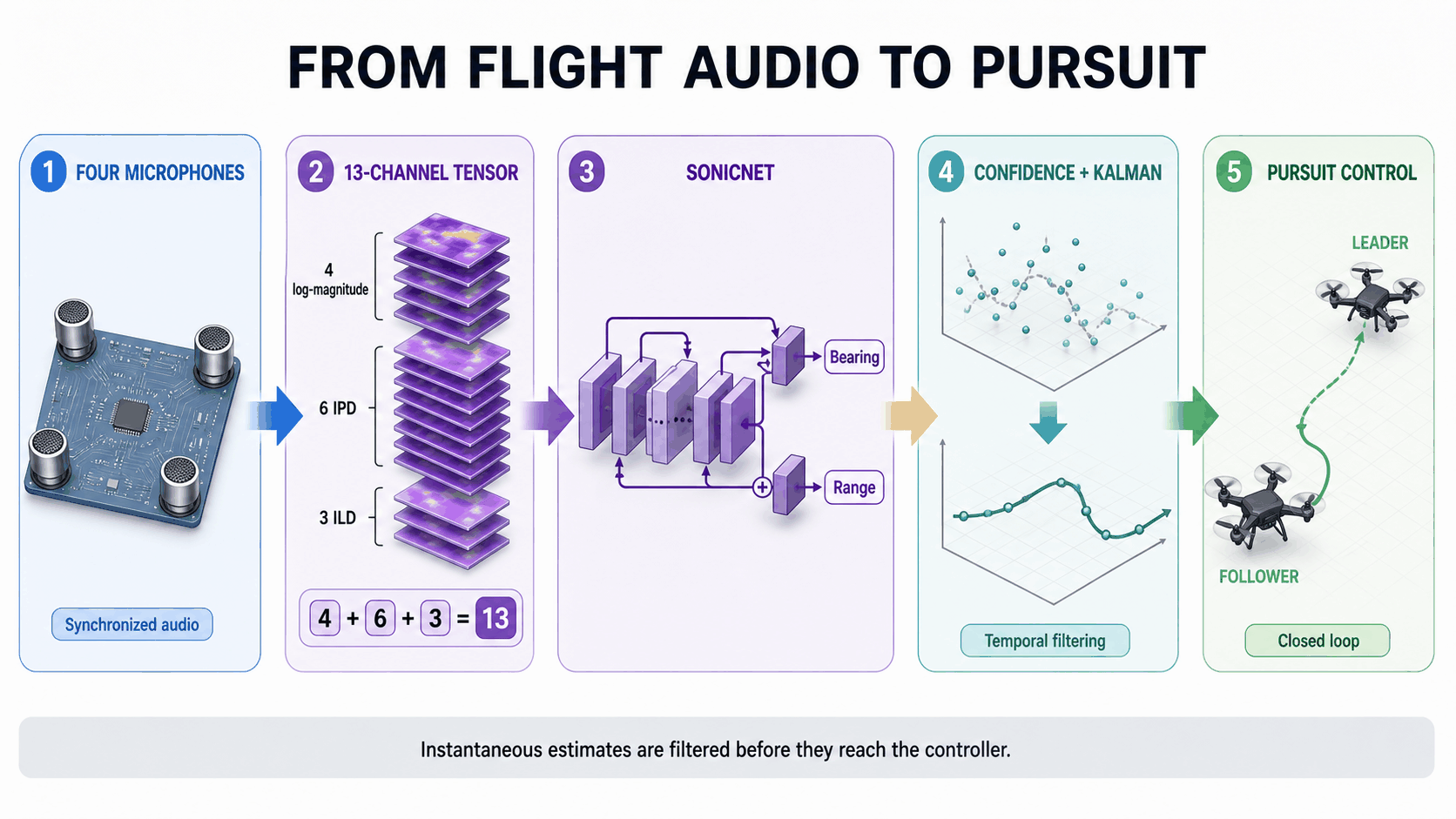
The onboard pipeline converts synchronized audio into bearing and range estimates, filters them over time, and only then passes the relative state to the pursuit controller. Original Sigmoidal illustration.
The resulting tensor enters SonicNet, a convolutional residual network with separate heads for bearing and range. Bearing is represented by sine and cosine components, avoiding the discontinuity between  and
and  . Range is learned in normalized logarithmic space. The complete network contains 1.73 million trainable parameters.
The network’s instantaneous output is not sent directly to the controller. SonicFly computes a deployment-time confidence score from bearing consistency, range plausibility, and temporal continuity. Confidence hysteresis rejects unstable transitions, and a Kalman filter imposes temporal coherence before the relative state reaches the pursuit controller.
The paper explicitly notes that this confidence score is a heuristic, not a calibrated probability. This distinction prevents the tracker from being interpreted as an uncertainty model that has received formal probabilistic calibration.
How was the system trained without giving away the answer?
The final dataset contains 140 minutes of paired outdoor flight. During primary data collection, RTK-derived relative pose supplied labels and allowed a conventional controller to cover horizontal separations from 1.5 to 7 m. Data were split by complete flight runs, rather than by adjacent audio windows, to reduce temporal leakage between training and final evaluation.
RTK-GPS therefore played two limited roles: creating ground-truth labels and supporting post hoc evaluation. During acoustic pursuit, no leader GPS or RTK position was provided to the neural estimator, confidence module, Kalman filter, or pursuit controller. The claim is not that the research process used no external reference; it is that the deployed perception-control loop did not consume the leader’s position.
The training objective combines circular bearing error, range error, and the implied Cartesian position error. Long-range underestimation receives additional weight because it can cause a follower to fall behind a leader whose acoustic signal is already attenuating. This is a useful example of aligning a learning objective with the physical risk of the downstream control task.
What do the results actually establish?
On held-out onboard flight data, confidence-gated filtering produced a 31.2° bearing mean absolute error and a 1.49 m range root mean square error. Raw predictions were less accurate, with 45.7° bearing MAE and 1.68 m range RMSE in the reported distance-dependent analysis.
For closed-loop acoustic pursuit, the desired separation was 3.5 m and the reported mean distance-maintenance error was 1.34 m. The follower remained within the specified lateral band for 75% of the default-trajectory duration, 80% of the reverse-trajectory duration, and 78% overall. The authors also evaluated more than twenty trajectory geometries, including straight, curved, S-shaped, and sharp-turning paths.
These figures establish feasibility, but they do not describe high-precision formation control. A 31.2° mean absolute bearing error remains substantial. Performance depends on acoustic attenuation, environmental disturbances, target geometry, and the deliberate spectral distinction between the two aircraft. The experiments also involve one leader and one follower, not dense multi-robot traffic.
The strongest conclusion is narrower and more useful: the recovered state was accurate enough to support approximate outdoor pursuit under the tested conditions. That converts an acoustic signal from an interesting classifier input into part of a working perception-action loop.
Where does acoustic sensing fit among other drone sensors?
SonicFly is not presented as a replacement for cameras, LiDAR, radar, GPS, or radio-frequency ranging. Its value lies in complementarity. Passive acoustics does not require illumination, does not need a direct visual observation of the leader, and uses a small, low-power sensor payload. It can provide another source of evidence when visibility, infrastructure, or communication is constrained.
Its limitations are equally physical. Sound intensity decreases with distance. Wind and turbulence perturb propagation. Higher-frequency components offer finer spatial information but attenuate more rapidly and face phase ambiguity. At very short distances, wake interaction and rapidly changing geometry can also degrade estimates. The paper reports that localization error was lowest at intermediate ranges rather than improving monotonically as the drones approached each other.
A robust aerial system would therefore fuse acoustics with other modalities instead of treating one sensor as universally sufficient. The broader engineering lesson is that signals normally classified as disturbances can become informative when platform mechanics, sensor geometry, representations, and control are designed as one system.
The authors provide the official SonicFly project page and a public repository with code, pretrained weights, and dataset instructions for closer inspection.
Takeaways
- Flight sound contains structured information. Rotor geometry and operating speed produce harmonic patterns that can support relative perception.
- The follower must listen through its own noise. SonicFly combines spectral features, phase and level differences, a neural estimator, confidence gating, and temporal filtering.
- The results demonstrate pursuit, not precise formation. A 1.34 m mean distance-maintenance error was sufficient for approximate closed-loop following under the evaluated conditions.
- Platform design is part of perception. Different blade counts and a deliberate microphone geometry make the learning problem more observable.
- Acoustics is a complementary modality. Its lightweight, passive operation is useful, but attenuation, wind, geometry, and single-target evaluation remain important limits.